
The subject of cocktails can be tricky when the launching point is distilled spirits. More specifically, when bottles are marketed or recommended for use in cocktails, they’re often viewed in a dismissive manner. After all, if a spirit isn’t enjoyable neat but can be incorporated into a good (even great) cocktail, then surely that’s a sign of an inferior product. I’ll admit that I still slip into this mentality from time to time. Tasting whiskey neat, though still niche, is far more in vogue now than it’s been for several years. It’s to the point that the measure of a whiskey’s quality effectively boils down to how it stands up without any added ingredients.
Yet the more liquor I try (and more cooking I do with The Deglutenizer), the more I realize how fundamentally flawed this perspective is. Strictly seeing whiskey as something meant to be consumed neat is not only restrictive thinking, it’s downright stale. Doctoring up a truly expensive bottle to make it more enjoyable can make the original purchase feel cheapened, but if the final result is ultimately preferred, then what harm is being done? I emphasize this point since the subject of today’s review is a whiskey intended for use in cocktails.
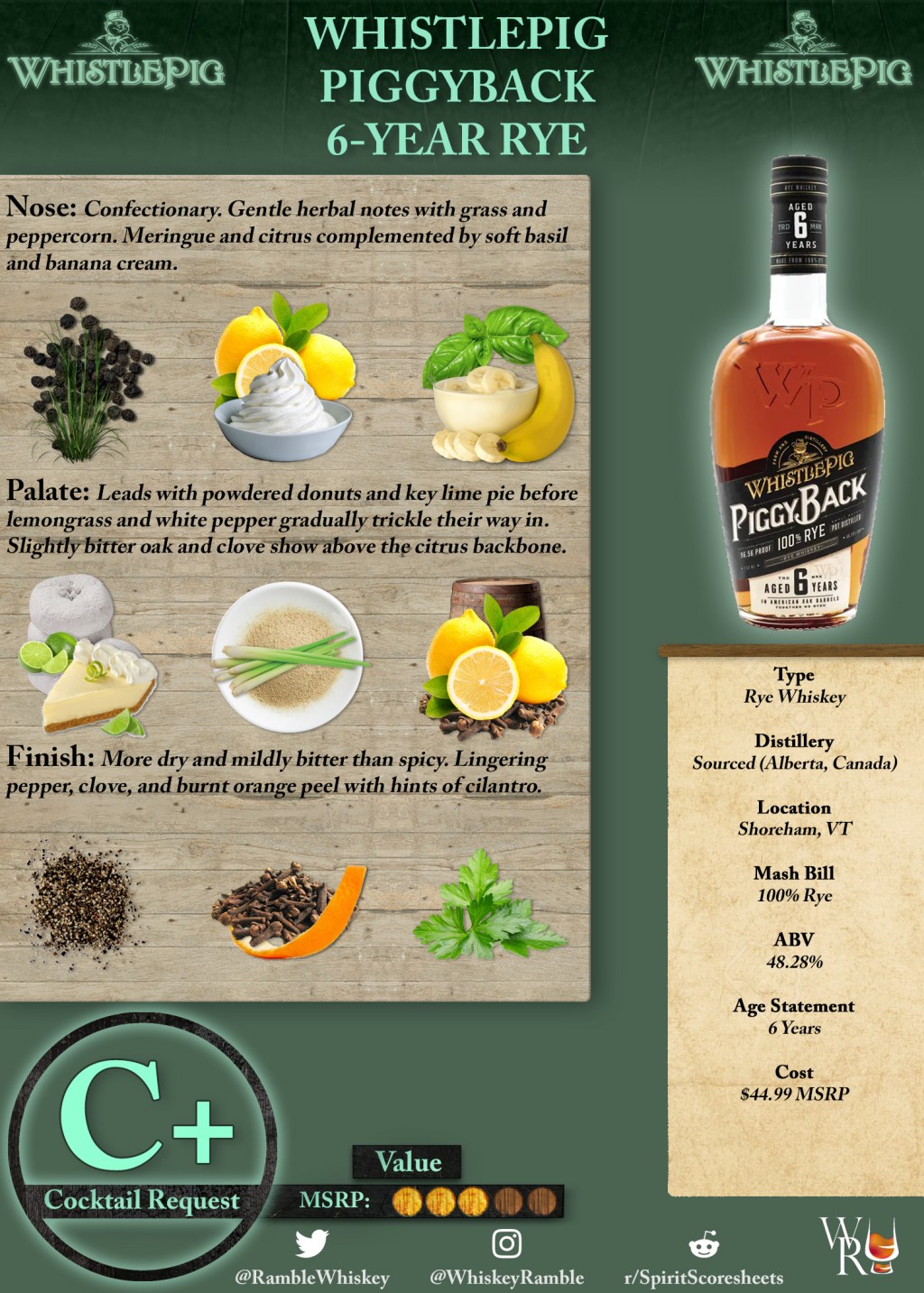
WhistlePig isn’t so much a fresh face as much as it is a seldom sighting in my bar. The reason? More times than not, pricing. For a time, the least expensive WhistlePig option was their 10-Year, which I’ll admit giving suspiciously high marks to at the time of review. The brand has since introduced a plethora of new options, some permanent and others limited runs. Pricing for most of these has mostly run the gamut between slightly more agreeable and par for the course, depending on the expression. One of the first to hit the market was PiggyBack Rye, a permanent addition pot distilled from 100% rye and aged for 6 years in American oak.
PiggyBack was one of the last bottles Dave Pickerell helped curate before passing in 2018. As such, the bottle contains a couple small details, such as Pickerell’s years of birth and death (1956 and 2018, respectively) and the pig mascot wearing a Stetson hat, as opposed to the usual top hat. WhistlePig also chose to market PiggyBack in a way that realizes Pickerell’s dream of “creating the best aged rye whiskey for your cocktail,” as if implying that unaged whiskeys are a common sight at local bars.
On a less facetious note, the whiskey is meant to be a nod by Pickerell to bartenders, right down the ergonomic bottle design. The final product is bottled at an oddly specific 48.28% ABV and retails between $40-$50. Although this positions PiggyBack as WhistlePig’s most entry-level bottle, it still costs more than the more upscale options of some other brands. Anyone who’s familiar with WhistlePig is likely accustomed to this, given how the brand positions itself as a more premium offering. Whether that premium is justified will naturally vary from person to person, especially considering the all-but-confirmed likelihood of the Vermont producer sourcing rye from Alberta Distillers Limited in Canada. Let’s see how it stacks up on its own before seeing how it fares as a cocktail base.
Nose: Confectionary. Presents a few traditional rye notes like herbs, grass, and peppercorns, but in a fairly gentle way. Meringue and citrus notes with soft basil and banana cream to round it out. Although the foundations for use in cocktails are evident, this neat pour offers an intriguing aroma.
Palate: Leads with confectionary notes again—think powdered donuts meets key lime pie—before lemongrass and white pepper gradually trickle their way in. Slightly bitter oak and herbal notes (namely clove) creep up, but they’re supplemental to the soft, citrusy backbone.
Finish: More dry and mildly bitter than spicy. Lingering pepper, clove, and burnt orange peel with hints of cilantro drive home this pour’s place in drinks like a Sazerac.
You might be scratching your head, wondering why anyone would evaluate a whiskey neat when it’s clearly intended for cocktails. But when we consider that cocktails are fundamentally recipes, it’s easy to see overlap between them and food. Sometimes cooks will taste individual ingredients on their own to get a better idea of what they’re working with and how to utilize them. Similar applies here. That and I simply enjoy jotting down notes from neat pours.
To that end, there a couple ways I can look at PiggyBack Rye. I actually find it somewhat competent as a neat pour, but mainly from an appreciate standpoint. Would I request a pour of it neat? Almost certainly not. In fact, I’d be remiss to say it’s substandard in that context. However, it’s crystal-clear that cocktails is where this whiskey belongs, even if we remove the bottle’s branding. Much of what PiggyBack offers is fun but half-baked; you can tell it benefits from playing with other ingredients. Not to mention our exposure to PiggyBack Rye was from a Sazerac ordered at Oak & Ember, which both peaked our interest in the cocktail and whiskey.
Where PiggyBack Rye feels the most held back, like other WhistlePig products, is in its price point. I’m glad there’s a more affordable option than the frankly superior 10-Year, but it’s not enough to incentivize choosing over other, often more budget-friendly options. The two main draws going for WhistlePig here is the branding and use of 100% Canadian rye, and only one of those ultimately makes a truly lasting impact. That impact might be noticeable, especially if you happen to have a preference for it. Otherwise? It’s tough to look at PiggyBack as a better option than many other ryes in the $50 range (or cheaper), even if it’s a soundly priced option in its own right.
 thewhiskeyramble.com
Leave a comment