
Consistency is almost certainly one of Johnnie Walker’s guiding principles. Diageo’s mass market scotch brand is instantly recognizable thanks to the iconic bottle design, right down the logo. With this level of ubiquity, it’s of no surprise that some options in the Johnnie Walker portfolio might leave discerning drinkers with more questions than answers. Case in point: Gold Label Reserve.
Originally introduced as Gold Label The Centenary Blend 18-Year, Diageo discontinued it around 2012-2013 before relaunching it as Gold Label Reserve, a NAS expression. What happened to the 18-year whisky? That went to the then Aged 18 Years (formerly Platinum Label). This meant Diageo could reap the benefit of enticing people with the Gold’s established pedigree while luring other shoppers in with a fresh bottle touting an attractive age statement. Gold Label Reserve still exists in the upper half of Johnnie Walker’s rainbow of a lineup, just between the Green Label 15-Year and aforementioned Platinum 18-Year. However, this also makes Gold Label Reserve the second most expensive core Johnnie Walker bottle behind Blue Label. So what makes the Gold Label stand out in its current form?
Tough to say. All that the brand’s site mentions is that whiskies in the blend were selected “for their sweet, honeyed qualities.” A quick Google search shows that Gold Label Reserve’s components come from an expected variety of regions, including Speyside, Islay, Highlands, and Lowlands. More specifically (and according to Master of Malt), Clynelish is used as the core single malt while Cardhu, Blair Athol, and Cameronbridge play a more supplementary role. Pricing also seems to be highly erratic and market-dependent, with local costs running as high as $87 but other areas going as low as $45.
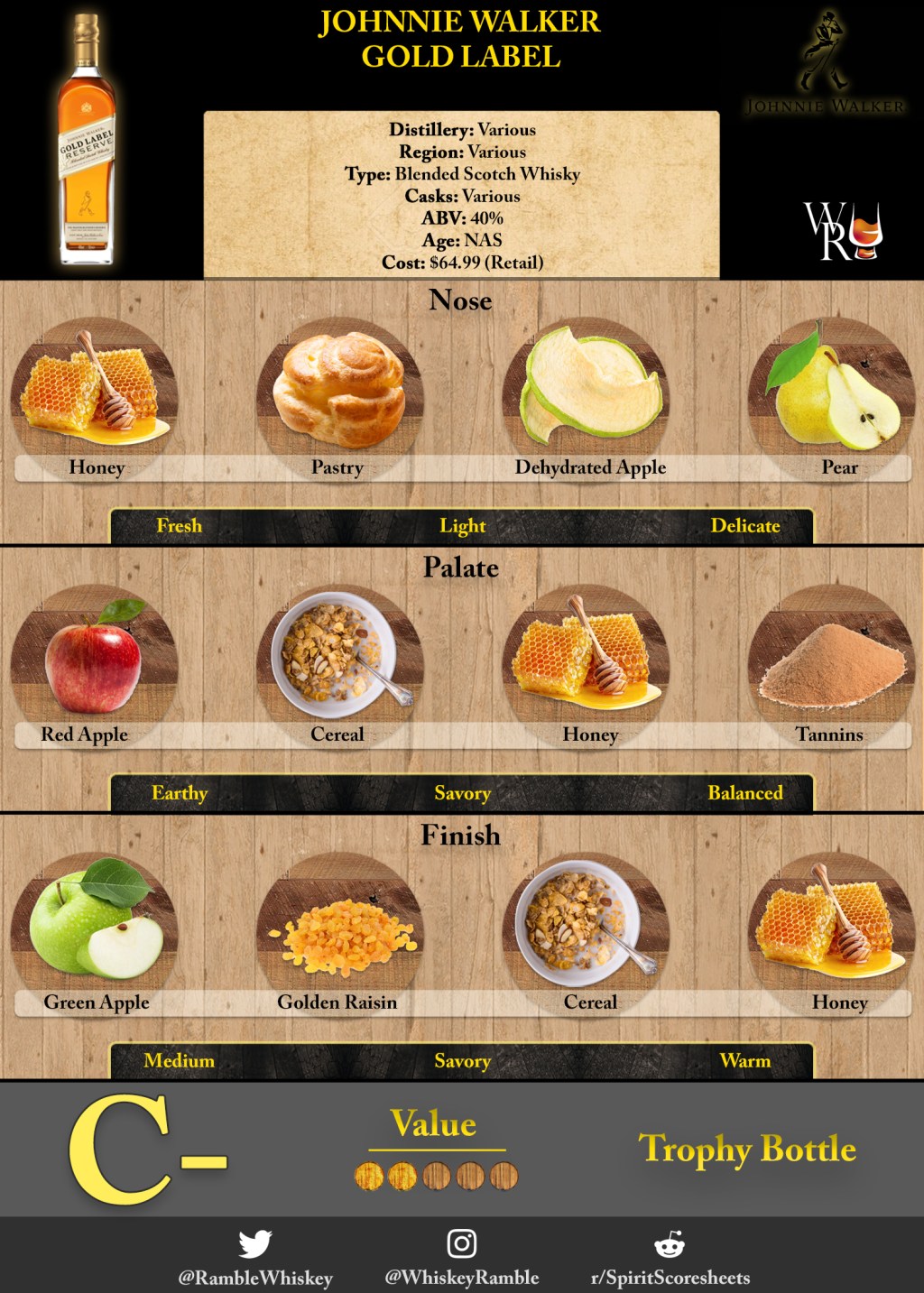
Nose: Honey, Pastry, Dehydrated Apple, Pear
Fresh, Light, Delicate
Palate: Red Apple, Cereal, Honey, Tannins
Bright, Watery, Metallic
Finish: Green Apple, Golden Raisin, Cereal, Honey
Short, Mild, Bitter
It’s incredible how much emotion Johnnie Walker Gold Label Reserve makes me feel considering how woefully uninspiring the actual whisky is. The first two times I tried Gold Label Reserve were shortly after having Johnnie Walker Black, and both times I was utterly flabbergasted by how dull the experience was. My third and final time trying it for review was my preliminary pour, and although it began to grow on me, the final impressions were effectively the same. There’s a fine line between a pour that’s delicate and one that’s boring. Johnnie Walker Red Label, for example, is a perfect example of the former. Gold Label might lean closer to the delicate end of the spectrum, but that’s like saying a 10-year product tastes more mature than an 8-year product.
Of the Johnnie Walker products I’ve tried thus far, this is the last one I’d suggest purchasing. At least with the Red Label you know what the experience will be like just from the price point. Gold Label Reserve is effectively a slightly more mature, less ashy, and marginally more competent Red Label. Will it impress people who don’t know any better and are easily influenced by shinier packaging? Perhaps. But those with discerning palates will get far more fulfilling whisky for the price in several other places.
 thewhiskeyramble.com
Leave a comment