
The past and present history of Early Times might be one of the most jarring yet emblematic in American whiskey. Going from the most popular Kentucky bourbon of the 1950s to a line seemingly caught in flux during its latest exchange of hands, Early Times Bottled in Bond has seen everything from success to irrelevance and even a degree of enthusiast scrutiny. Yet every brand starts somewhere, and the genesis of the Early Times name really set the stage for the brand more or less exemplifying whiskey throughout time.
Early Times began around the 1860s when John Henry “Jack” Beam and A.G. Nall created the brand. The name was meant to tribute an “old school” way of producing whiskey by “mashing grain in small tubs and distilling the whisky in copper stills over open fires.” Turns out that marketing whiskey as some form of “old fashioned” style wasn’t uncommon, even 160 years ago. The original distillery was built in Bardstown, KY, joined by Jack Beam and A.G. Nall as a triplet of brands produced at that location. Other than the Panic of 1884, when Jack Beam lost financial control of the distillery, business effectively continued as normal until 1918.
Somewhat ironically, this distillery is where Brown-Forman did their medicinal bottling during Prohibition after purchasing it (and its stocks) from S.J. Guthrie around 1923. However, the key distinction here is bottling, because that very distillery would never produce whiskey again.
The Early Times name would continue on after Prohibition ended, however, as Brown-Forman bought the Old Kentucky Distillery (DSP-KY-354), previously Mayflower Distillery Co., in Shively and renamed it to the Early Times Distillery. Production saw the introduction of Early Times Bottled in Bond in 1945, which soon became the best-selling Kentucky bourbon during the following decade.
However, the 50s also saw Brown-Forman acquire another whiskey giant: Jack Daniel’s (then Jack Daniel) in 1955. Whether coincidence or not, Early Times quickly became less of a focus, undoubtedly worsened by whiskey’s eventual downturn in popularity between the 60s and 80s. Even so, Brown-Forman made the equally curious yet innocuous decision to rename the Early Times Distillery to the Brown-Forman distillery between 2017 and 2018. Then in 2020, Brown-Forman sold the Early Times brand to Sazerac, which will see the brand continue production at the Barton 1792/Thomas Moore distillery (DSP-KY-12).
The transition brought a couple small updates to the existing Early Times Bottled in Bond bottle design. When I say small, I mean minute details like an ostensibly larger bottle (it’s still 1L), one different listed distillery on the back label, and the main distinction for most folks: a blue, aluminum cap versus a black plastic cap. Otherwise, at a cursory glance, the bottles are identical. And since the word on the street is that current Early Times Bottled in Bond bottles still contain the same bourbon distilled under Brown-Forman, that means it should taste similarly identical, right? Even brand representative Amy Preske (Public Relations Manager for Buffalo Trace and Sazerac) said that 1792 will produce with the same mash bill and proprietary yeast strain while in-house stocks come of age.
As it turns out, some individuals have had a contrary experience when comparing both iterations of this popular budget bonded product. Between Preske’s statement, the bottled in bond requirements, and the assumption that 1792 isn’t using different whiskey in the final product (yet), one would suspect the transition to be smooth as a bottle of Weller. Yet the reality seems to be more shaky than anything. The only two possible explanations I can present are that the blending teams are going for a different profile (one closer to 1792 than Brown-Forman) and/or some of the whiskey finished aging at Bardstown. The latter makes more sense when we consider that, unlike most distilleries, many of Brown-Forman’s rickhouses are made from masonry instead of wood, with steam-heated pipes being used to regulate internal temperatures (aka heat cycling).
However, I must emphasize that both are simply a pair of speculations on my part. Could either be possible? Sure. But there’s a considerable margin between possibility and probability, and yet another margin between probability and certainty. Besides, we haven’t even spoken about how the current Early Times Bottled in Bond fares. As with the Brown-Forman iteration, it comes in a 1L bottle and retails for around $20-$25, already making it a highly competitive product from a sheer statistics standpoint. One final note worth mentioning is the distillery sites on the back label; both mention DSP-KY-354 (Early Times), but the previous version also showed DSP-KY-414 (Brown-Forman site in either Shelbyville or Louisville) while the current version mentions DSP-KY-12 (Barton 1792/Thomas Moore) in its place.
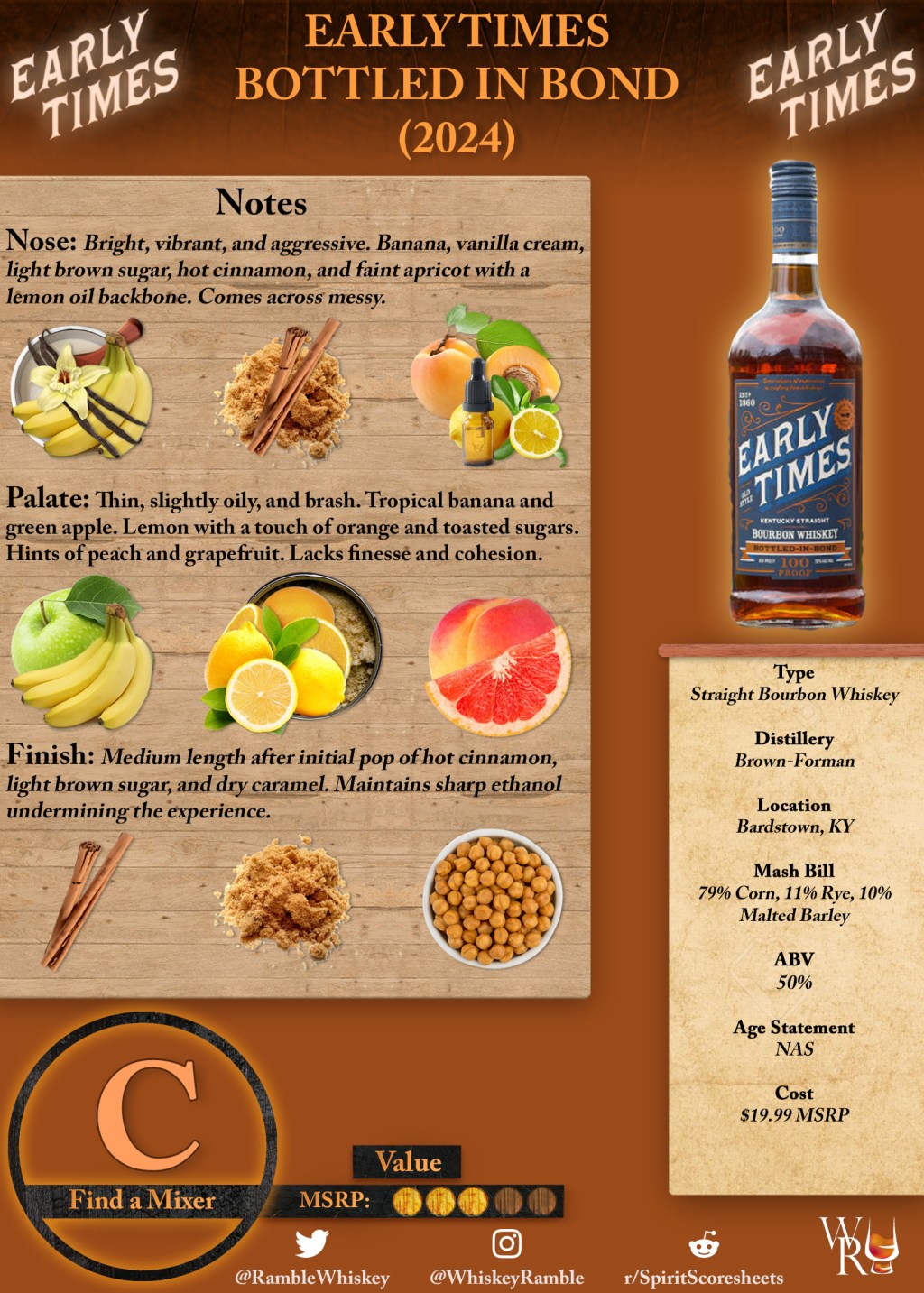
Nose: Bright, vibrant, and decently fruity backbone. Admittedly a bit on the aggressive side. Banana, vanilla cream, light brown sugar, hot cinnamon, and faint apricot above a citrus (lemon) oil backbone. The individual notes might be pleasant, but they’re far from cohesive.
Palate: Thin with a slight degree of oiliness. Brash and alcohol-forward while the banana from the nose takes a tropical turn, along with some green apple. Lemon citrus presents with a touch of orange and toasted sugars. Hints of peach and grapefruit start to creep in, but fade before leaving a fleeting impression. Like the nose, everything lacks finesse and cohesion.
Finish: Medium length after an initial pop of hot cinnamon, light brown sugar, and dry caramel. The aggression from the palate holds true here with sharp ethanol cutting through the experience.
Based on memory, the previous version of Early Times Bottled in Bond held up as an easygoing, quality, and budget pour. It effectively checked the boxes one looks for in a modern bourbon for average, working class individuals. Even without the value proposition, it was a competent whiskey.
Unfortunately, I can’t report to feeling the same way about this more present bottling. The drinking experience feels akin to a stripped down version of Old Forester 1920 or 1792 Full Proof, which is to say it brazenly delivers mixed results. When looking at the individual tasting notes, Early Times Bottled in Bond might sound like a decent enough whiskey, and truth be told, it is. Warming up with another pour or adding some water should help, and I’ve had success incorporating it into cocktails, so it’s a viable option in the right context. Yet I generally focus on neat pours here, and I can’t say this take on Early Times does much for me there.
Whether my lack of enthusiasm is due to my shifting palate (it’s been several months since I last tried Early Times Bottled in Bond) or batching woes, I suspect it’ll be a while before I give this new-to-Sazerac brand another shot. Part of me wonders if the potentially different profile was simply inevitable due to a lack of control, or if the tasting team want Early Times to taste different, now that it’s exchanged hands. I imagine Sazerac would like to make Early Times feel like one of their expressions rather than a Brown-Forman lost in translation, so giving it a different profile or identity makes some degree of sense. However, part of me wants to say it’d be wise to preserve more of what people loved about the last version while expanding the brand in other ways. Maybe I’m giving this sub-$30 bottle of whiskey too much thought. Yet more affordable bottles tend to be better sellers, so I think it’s worth some consideration.
 thewhiskeyramble.com
Leave a comment