
One of the whiskey industry’s more confusing aspects for newcomers is keeping track of all the names out there. Legacy distilleries aren’t too difficult to keep straight in and of themselves, but factor in the many fresh faces from the past 15 years, along with brands produced from the new and old guard alike, and things can suddenly get muddy. Then there’s the surprisingly common occurrence of distilleries undergoing name changes. Case in point: Michter’s.
Although the Michter’s brand name can be traced back to the 1950s, the original distillery in Pennsylvania underwent a couple of prior name changes. John Shenk founded the distillery in 1753, going by the name Shenk’s until Abraham Bomberger, a Dutchman with ties to the Shenk family, purchased and ultimately renamed the distillery in 1861. The name change was followed by a series of expansions and renovations, including enlargements to “both the Warehouse and Jug House, probably during the 1880s,” according to a National Register form from January 16, 1980.
Horst, one of Abraham’s sons, took over operations at the distillery until selling it to Ephraim Sechrist around the time that Prohibition began. As with many distilleries during this time, Bomberger’s was effectively non-operational until 1934, when Sechrist added a three-story bottling plant made of brick. The last major noted construction to this original distillery was the erection of three cement block warehouses in 1950, each with room for 20,000 barrels. 1950 was also the year that Louis Forman repurchased the distillery after initially buying and selling it in 1942, due to him being drafted. Between those years, Bomberger’s was owned by Logansport Distilling Company, which became a subsidiary of Schenley.
By the time Forman assumed ownership of the distillery in 1950, he consulted Charles Everett Beam to cultivate “a premium niche market by making old-fashioned pot-still mash whiskey.” It was around this point that Forman changed the distillery name from Bomberger’s to Michter’s, combining the first names of his two sons, Michael and Peter. The original distillery, located in Newmanstown, PA, closed in 1989 (my birth year).
This is where the Legacy Series under the current Michter’s brand comes in. It consists of a pair of annual releases named after the original distillery’s first two names: Shenk’s Homestead and Bomberger’s Declaration, both of which launched in the 2010s. We’re focusing on the latter today, and it’s an expression I’ve long wanted to tackle.
Bomberger’s Declaration isn’t a particularly striking whiskey at first glance. The bottle and label design may have an old school charm, but I’m also reminded of certain armagnac bottles. Beyond that, it appears to be little more than a small batch, NAS bourbon bottled at 54% ABV. Yet this proofier sibling in Michter’s Legacy Series has a couple small tricks up its sleeve, both of which come down to the way its matured. Michter’s is one of the more tight-lipped whiskey producers out there, but we can infer some information from what they do actually tell us. In the case of Bomberger’s, it’s that some of the wood used comes from Quercus muehlenbergii.
Otherwise known as Chinquapin, this subspecies of American white oak takes its name from Lutheran pastor and amateur botanist Gotthilf Heinrich Ernst Muhlengerg. It mostly grows in the same regions as Quercus alba, including Michigan, Alabama, Texas, and (perhaps coincidentally) Pennsylvania. Master Distiller Dan McKee mentions that it doesn’t grow as tall as more traditionally used oak; “it’s a little shorter, a little curvier at the base, more branches, it’s actually harder to log,” but adds fruity, spicy, and chocolate notes to the whiskey. Although this oak is used as a distinguishing factor for Bomberger’s in marketing (albeit not on the bottle), Whiskey Magazine has reported that many oaks, including Chinquapin, have been used in whiskey production for several years and that, “once cut into staves, the only way to discern the species is through DNA testing.”
The final bit that Michter’s emphasizes with Bomberger’s production is how long they season the staves used. Leaving wood outside for a few months is hardly a rare occurrence in bourbon production, but for Bomberger’s, the oak seasons for three years prior to being toasted and charred to Andrea Wilson’s (Michter’s Master of Maturation) specifications. We don’t know how long the whiskey is aged for beyond the required four years for straight bourbon with no age statement, but if the color is anything to go off of, then age should be the least of our concerns.
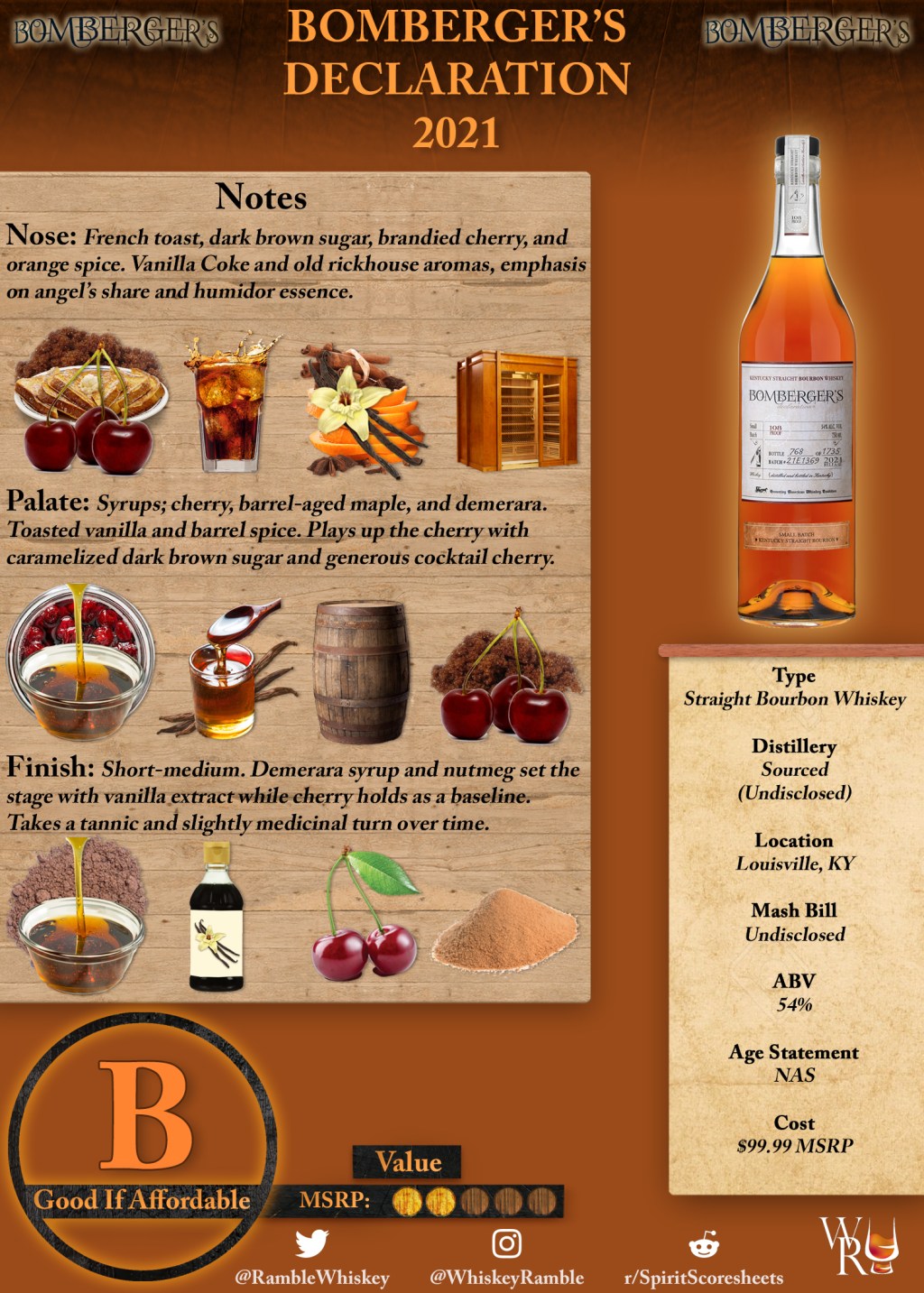
Nose: Classic, quintessential, and moderately rich aroma. French toast, dark brown sugar, brandied cherry, and orange spice. Syrupy, like Vanilla Coke extract with a growing presence of old rickhouse aromas, really emphasizing a combined essence of angel’s share and humidor. Not terribly complex, but good depth and appropriate flavor potency.
Palate: Syrups for days; think cherry, barrel-aged maple, and demerara. Toasted vanilla and barrel spice. Really plays up the cherry with some armagnac-adjacent notes from the nose; caramelized dark brown sugar with generous cocktail cherry influence.
Finish: Short-medium. Demerara syrup and nutmeg set the stage with vanilla extract while the cherry holds true throughout as a baseline. Starts taking a more tannic and slightly medicinal turn after a few sips.
I remember the first time I tried Bomberger’s. It was at a popular bar several miles away from my hometown. Their whiskey selection was frankly overwhelming, but I had a few mid-range bottles in mind that I wanted to try, including Bomberger’s. I didn’t get the year of the exact bottle, but I remember being struck by a banana’s foster meets maple syrup profile. This immediately made acquiring a bottle shoot towards the top of my list.
The first bottle I acquired was from a 2023 batch, which we’ll get to in due time. This 2021 bottle captures some of what I remember getting back at the bar, but with a couple differences. What stands out most to me is how ostensibly mature the whiskey smells and tastes. Michter’s won’t so much as suggest the age range for either of their legacy series releases, but if you served this whiskey to me blind, I’d likely place its age somewhere in the double digits. There’s a rich, syrupy nature to the whiskey that brings many tried-and-true bourbon notes to mind. It’s almost to the point of coming across heavy-handed after a few subsequent sips. This mainly presents on the finish, where things gradually become more tannic and even medicinal, neither of which I’m typically fond of. Breaking up the sips with water practically becomes a necessity to cut through those unpleasantries, but it’s also hardly dealbreaker.
If you asked me to name a bottle that encapsulates a traditional, well-aged bourbon profile, then the 2021 Bomberger’s Declaration would be near the top of my list. Despite not knowing the actual age, the profile feels spot-on for a whiskey that spent ample time maturing. It’s what I’d consider a quintessential bourbon in profile, aforementioned shortcomings be damned. If you have access to this particular iteration of Bomberger’s for around MSRP and enjoy oaky bourbons with few curveballs (if any), then it might be worth a pickup, so long as you don’t expect the world of it.

 thewhiskeyramble.com
Leave a comment