
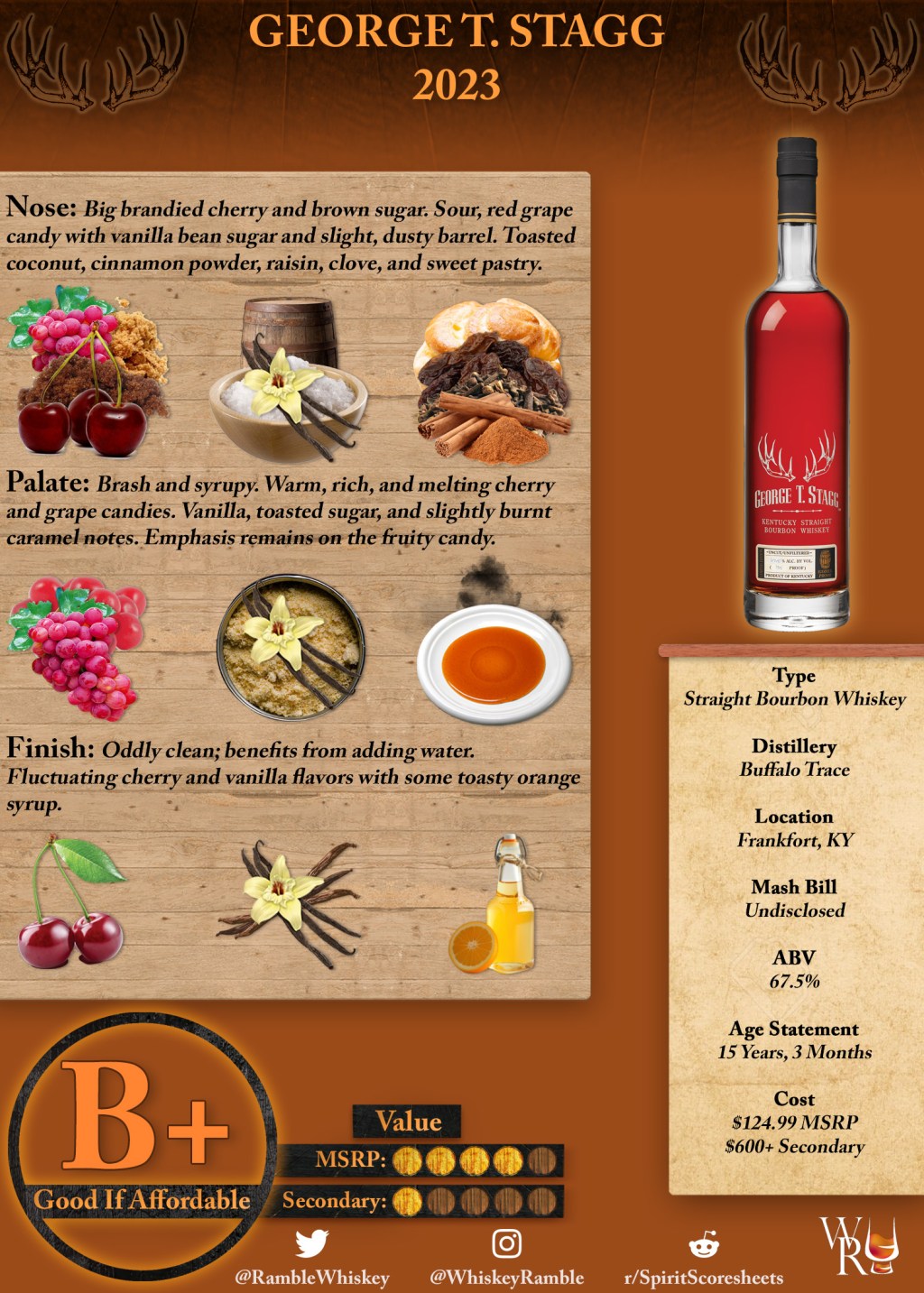
George T. Stagg is a name that requires little introduction to the bourbon-loving crowd. As a brand, it’s one of five bottles included in the annually released Buffalo Trace Antique Collection (BTAC). The one exception to this came in 2021, when the distillery held back barrels intended for George T. Stagg since they allegedly didn’t meet the team’s quality standards. This caused no shortage of uproars and conspiracies within bourbon groups, the least of which was the suspicion that some of said barrels may have ended up in the more regularly released Stagg (formerly Jr.) bottles. Such a response isn’t surprising, considering how esteemed the BTAC line is, especially since George T. Stagg and William Larue Weller, are often looked at as the crown jewels of this collection.
We’ll talk more about the whiskey itself that ends up in George T. Stagg bourbon, but I’m going to take the time to talk about the eponymous man behind the whiskey. Born December 19, 1835, in Garrard County, KY, George T. Stagg first made a name for himself after enlisting in the Union Army during the Civil War, during which he rose the ranks, eventually becoming Captain. Perhaps it’s of little surprise that his family wasn’t far removed from military experience; for example, his great-grandfather was a Regimental Commander in the New Jersey Militia during the Revolutionary War. Stagg also gained a reputation for bare-knuckle fist-fighting in the ring during his time as a soldier, which seems rather fitting for the bourbon he’s currently named after.
Following the war, Stagg moved to St. Louis, MO, and became a whiskey salesman. He initially bought barrels of O.F.C. and eventually went into business with the legendary Colonel E.H. Taylor, Jr. It was around this time that Taylor was dealing with financial hardships, which Stagg was able to assist with. They joined forces to create E.H. Taylor, Jr. & Co., with Stagg acting as President. However, this partnership would soon take a sour turn as the duo quickly began butting heads, culminating in Taylor exiting the company with Stagg agreeing to remove Taylor’s name from all of the stocks he owned. Yet Stagg understood the pedigree behind Taylor’s name, given his penchant for prioritizing quality products, so he left the Taylor name on the corporate letterhead. After a series of expensive lawsuits, the men reached a settlement in 1890, with Stagg changing the company name to George C. Stagg & Co.
The settlement preceded a series of tumultuous events for both of the men and whiskey in general, with Stagg passing away three years later, Taylor passing the Bottled in Bond act in 1897, and the United States entering Prohibition in 1920 until Repeal Day in 1933. According to Buffalo Trace, Stagg’s distillery operated during Prohibition as “one of only four such distilleries to remain open during that period,” yet it’s known that six distilleries procured permits to produce whiskey for medicinal purposes during that time: Brown-Forman, Glenmore, Frankfort, Schenley, American Medicinal Spirits, and A. Ph. Stitzel. As far as I can tell, the Stagg distillery became a part of Schenley during the year of Repeal (1933), and Explore KY History claims the O.F.C. Distillery (which Stagg owned) was issued a permit prior to being acquired by Schenley. However, where it gets fuzzier is with VinePair reporting that the George T. Stagg distillery was known as Frankfort Distillery at the time, but Frankfort, which received a permit, was acquired by Paul Jones & Co., in 1922, and sold whiskey under names like “Antique” and “Four Roses.” In fact, if you comb through the Four Roses brand history on their site, they mention the Frankfort Distillery in question while Buffalo Trace doesn’t seem to. So yeah, muddy stuff from what I could find.
Coming back to the Antique Collection itself, the full lineup as we know it today began in 2005, but the earliest bottles appeared in the year 2000 with Sazerac 18, Eagle Rare 17, and Weller 19. George T. Stagg was officially introduced in 2002 and, for a while, would often come bottled at hazmat strength (70% ABV or higher). George T. Stagg bourbon is bottled at cask strength without chill filtration and is always aged a minimum of 15 years. Per the Buffalo Trace newsletter, the 2023 batch was aged for 15 years and 3 months, experienced a 68% evaporation loss, and was distilled from Distiller’s Grade #1 and #2 corn, Minnesota rye, and North Dakota malted barley. The warehouses used for this release were C, I, K, L, and M on floors 1-5, but the floors per warehouse weren’t disclosed. MSRP is around $125, but realistic pricing between secondary and non-state-controlled stores is closer to $600 or more. I managed to secure a bottle for $144 after tax.
Nose: If you love Buffalo Trace, you’ll be at home here. Big punch of dirty/brandied cherry and brown sugar. Red grape candy comes across in a sour, yet pleasant way, along with hints of vanilla bean sugar and a slight, dusty barrel note that occasionally peaks out. Over time, that dusty barrel aspect develops, bringing forth toasted coconut, cinnamon powder, raisin, and clove. After sipping, I get a sweet pastry aroma.
Palate: Brash and syrupy; the density and texture are on point. Warm, concentrated, and melting cherry and grape candies. Nicely integrated vanilla, toasted sugar, and slightly burnt caramel notes. Emphasis is still very much on the fruity candy flavors.
Finish: Oddly clean when all is said and done; adding water seems to let the actual flavors take over and leave more of an impression. Ebbs and flows with expected cherry and vanilla power play. Toasty orange syrup component emerges as well, but everything feels surprisingly short-lived.
I’ve reviewed no shortage of Buffalo Trace products since creating this blog. Many of these have been courtesy of samples, since obtaining most Buffalo Trace expressions for anywhere close MSRP can feel like finding an insurance company that actually cares about you. As a result, I’ve become one of those jaded folks when it comes to the Frankfort distillery. It’s to the point that if I find a remotely sought-after Buffalo Trace bottle for a decent asking price, I’m looking at it more as trade fodder than anything. Furthermore, the only reason I even came into a bottle of George T. Stagg is because I got lucky with a Vault invitation through ABC Fine Wine & Spirits. I figured I’d see about what bottle(s) I could fetch for it when I picked it up…until I had the actual BTAC bottle in-hand. At that moment, the part of me that used to love and hold George T. Stagg as his dream bottle crept out. I had to open it.
Imagine my confusion when my initial impressions were, “that’s it?”
Perhaps I shouldn’t be surprised, considering my recent combination of apathy and aversion to the Buffalo Trace profile. Yet even when I wasn’t floored by a Stagg product, I still found myself regarding it quite highly. However, my experience with the 2023 Goerge T. Stagg was conflicted in every sense of the word. The endearing qualities I remember from when I tried previous batches years ago are present here, but in a far more diminished sense. “Complexity” isn’t a word that springs to mind when I think of George T. Stagg, so that the 2023 version continued that trend wasn’t a letdown. Now depth and enjoyable flavors? That’s a different story. I’ve considered those the hallmarks of this annual release, or at least of the previous ones I tried.
Last year’s George T. Stagg does exhibit those aspects, but only to a moderate degree. “Great” feels like a, well, great way to describe the overall experience. The balance of grain to oak is surprisingly sound considering the age and bottling strength. In fact, as someone who never adds water to their whiskey, I found this bottle to benefit from the inclusion of some H2O. Although some of the flavors mellowed out and became less exciting, it was all the more palatable for it. The biggest surprise came on the finish, becoming lengthier, creamier, and simply more pleasant. Altogether, I found it to be a fair trade-off that neither improved nor diminished the whiskey in a truly significant way.
My affinity for Buffalo Trace products has gradually waned over the years, and the 2023 George T. Stagg feels like a perfect encapsulation of this. That so many people seem to hold BTAC up on a pedestal is likely influencing my general disappointment for this particular release, despite the fact that it’s absolutely a strong product when looked at in a vacuum. This is why I believe it still earns solid praise. Yet I’d be remiss to say I think this is an extraordinary product that deserves legendary status well above many other bourbons. Part of me is bummed that this ostensible holy grail of whiskey left me unimpressed, especially considering how well regarded the 2022 edition was. At the same time, I’m also relieved. It means that future releases could just as easily be this enjoyable, and as long as that’s the case, I have next to no reason to fret over missing this BTAC label in the future.
…
As you probably noticed from the post title, this marks my 300th review as The Whiskey Ramble. I’m far from the most prolific spirits blogger/reviewer out there, but I’m still surprised that I stuck with it this much. Much of that likely stems from the combination of being an English and Journalism major as well as getting my feet wet doing videogame and album reviews. Expressing my thoughts while researching—so that I’m somewhat informed on what I’m talking about—has long been a creative outlet that challenges my analytical and communication skills. It’s also been surprisingly time-consuming, especially as a one-man show. To be clear, this is how I prefer to run things; I have no grand ambitions to turn this into a second source of income or actual brand. The idea is nice, but the reality is neither simple nor practical, given how niche whiskey will continue to be.
For a while, my plan was to get into a groove by reviewing at least one whiskey per week, with my somewhat recently introduced Just the Sip reviews being a way to churn out more at a greater frequency. Unfortunately, pumping out content with that level of consistency has quickly made reviewing feel more like a second job than a fun little hobby. And while getting paid to do this would genuinely interest me, that simply isn’t the case. Like most of you, I work a full-time job and have ongoing responsibilities that take their toll, so turning a hobby into what feels like an unpaid internship to myself doesn’t exactly pair well.
Compounding this situation is how I’ve amassed quite a backlog of bottles and samples. Once again, my collection is meager compared to some folks, but over 100 bottles and nearly as many samples is far more than any one person should probably have. What’s made this worse is I’ve been determined to review as many bottles and samples as possible, practicality be damned. You can probably see how this rapidly complicates things for someone like me.
All of this is to say that I’m very much feeling the burnout of producing content (I vomited a little writing those words). I still absolutely enjoy the reviewing process, from acquiring a bottle/sample to researching, writing my thoughts, and throwing the scoresheets together. Yet the more I try to force it on top of other, greater commitments in life, the less enjoyable it becomes. I’d much rather scale things back in the interest of preserving my affinity for this hobby. I’m not done reviewing, far from it. Rather, this simply means I’ll post less frequently. Instead of feeling obligated to keep a set schedule going, I’ll likely do occasional posts when the natural desire kicks in. How often? It could be every week or two, or once a month (if that). All of this may have been a needlessly long-winded way to say that I need to slow down, but there’s a reason I chose “ramble” for my blog name.
 thewhiskeyramble.com
Leave a comment