
Green River might have one of the best comeback stories still in progress. Going from a highly publicized operation in its heyday to one of several defunct distilleries in the 20th century, only to be resurrected as a place producing rapid-aged whiskey (then called O.Z. Tyler), things appeared fuzzy for the modern day Green River. Thankfully, the Owensboro distillery made a quick course correction, releasing more traditional products in the past couple of years. The brand has since established a strong foothold as one of the more value-oriented whiskey producers. This already makes Green River an attractive name as interest in whiskey gradually levels outs along with decreased spending budgets. What makes the deal even sweeter? The fact Green River produces some pretty solid whiskey.
Even if you haven’t tried whiskey from one of Green River’s in-house bottles, there’s still a decent chance you’ve tried it elsewhere. Blue Note and Wheel Horse are just two of the brands that regularly source their whiskey, with reception generally being positive. This reception followed the release of Green River’s own whiskey bottles, particularly the wheated bourbon, which I regarded as a safe, budget-conscious option in the best possible way. After checking some boxes with a rye bourbon, wheated bourbon, and rye whiskey, Green River then launched a product that many individuals were particularly excited for: a full proof bourbon.
I should mention that the word “full proof” is an ambiguous one to the more casual whiskey consumer. It’s understandable to think that this is just another variation of barrel proof, barrel strength, or cask strength, each of which mean the same thing: no water added between dumping the barrel(s) and bottling the final product. Until recently, the “full proof” designation has all but exclusively been used by Sazerac, more specifically with regards to 1792 Full Proof and Weller Full Proof. For those two products, full proof means that the bottling proof matches the barrel entry proof, so they’re batched and/or watered down after being dumped to meet a number. Conversely, Green River Full Proof is actually uncut, which I imagine will throw off the aforementioned casual whiskey consumers even more since the terminology isn’t consistent between brands.
Naming conventions aside, Green River Full Proof makes a mighty enticing case for itself. The initial press release alleged that the barrels comprising the blends are five to seven years old, but the product itself is NAS. Additionally, the press release mentioned that Green River utilizes tile warehouses for aging, meaning the whiskey likely ages differently compared to those matured in wooden warehouses. As I understand it, wood structures allow fluctuating temperatures to affect the contents (barrels) more seamlessly while stone creates a cooler, more humid environment. This typically results in lower proof points in the barrel, represented by the initial run of Green River Full Proof coming out at 58.65% ABV. One more curious point I’ve heard (from Amongst the Whiskey) is that Green River distills their whiskey on pot stills, with bourbonveach.com mentioning that they use a stainless steel column in combination with a pot still doubler.
Wrap all of these aspects together and we have a bottle with growing availability in 25 states and a competitive price point of around $50. Between the decent, touted age, high-rye mash bill (70% corn, 21% rye, 9% malted barley), bottling strength, and price point, Green River Full Proof feels like a prime competitor for Wild Turkey Rare Breed, which I consider the second best quality-to-value bourbon on the market, right behind Knob Creek Single Barrel. Does the whiskey have what it takes to stand up?
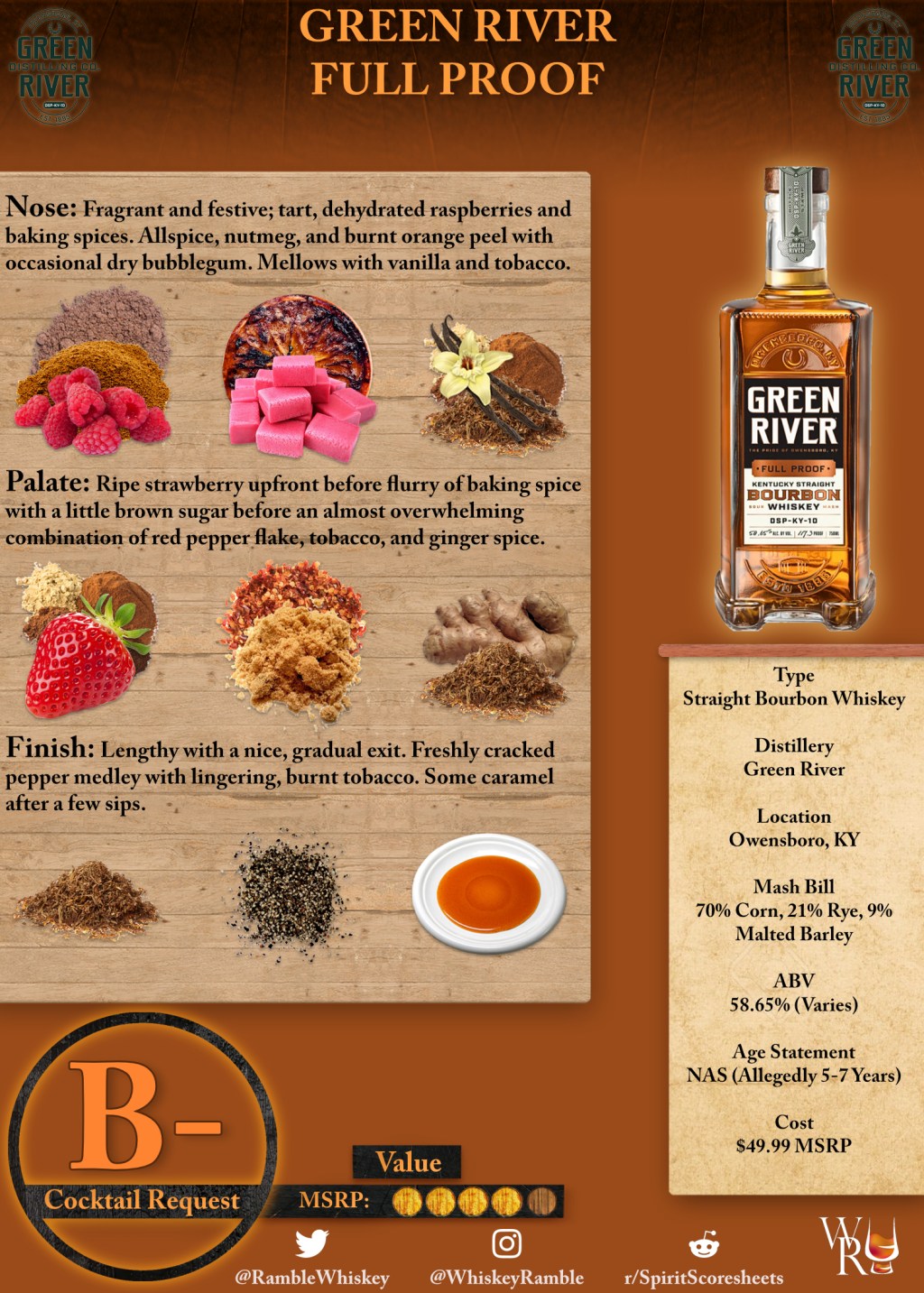
Nose: Immediately fragrant and festive with baking spices and tart, dehydrated raspberry. Allspice, nutmeg, and burnt orange peel leap out of the glass with a dry bubblegum note sneaking in here and there. Over time, the aromas mellow out with sweet vanilla and tobacco. Smells promising and reminiscent of the more baking spice-heavy Wild Turkey bourbons.
Palate: Ripe strawberry launches upfront while a flurry of baking spices kick in almost as quickly. Red pepper flake, tobacco, and ginger spice effectively overwhelm the initial burst of fruit. There’s a bit of the expected brown sugar notes in the transition, but the profile shifts rather abruptly.
Finish: Lengthy with a nice, gradual exit. Freshly cracked pepper medley takes center stage here with a lingering, burnt tobacco note. Caramel begins to present after three or four sips, but not in a particularly striking way.
One sensation I kept coming back to with Green River Full Proof was nostalgia. Although I previously tried a handful of bourbons sourced from Green River, none of them gave me the feeling of flashing back in time. Many have drawn comparisons between this and Wild Turkey Rare Breed, a comparison that I think is absolutely justified. Both land at around the same bottling strength (58.4% versus 58.65%) while pitching high-rye mash bills—although at 13%, Wild Turkey’s really isn’t, especially nowadays, and carrying neck-and-neck price tags. The cherry on top? Both bottles are pretty close in flavor profile.
However, the bottle that Green River Full Proof has me nostalgic for isn’t Rare Breed, but rather the previous bottlings of 101 bourbon. This has less to do with how similar the whiskeys taste and more the general experience I got on each. For the longest time, 101 (roughly from 2018 to 2021) came across particularly spice-heavy to me, especially as a then-new whiskey drinker. Green River Full Proof practically emulates this profile to a tee, especially after the split-second initial burst of fruit. It’s to the point that I’m caught off-guard by how quickly and prominently the spice (both heat and flavor) comes across. That profile naturally mellows out after subsequent sips without sipping water in-between, but the powerplay remains consistent.
Green River Full Proof feels like a product poised to leave a bigger impact than the neat drinking experience indicates. It’s honestly a bit of a bruiser and an easy whiskey to pick apart from a critical standpoint. However, this is without considering the competitive value proposition of a new, cask strength bourbon aged five to seven years for $50. As prices continue to trek upward across the board, including but not limited to whiskey, getting a promising, competent product like this isn’t just a breath of fresh air, but a reminder that good whiskey isn’t predicated on exorbitant prices.
What really pushes Green River Full Proof into the higher value realm for me, however, is actually how it performs in cocktails. I often feel the need to justify calling the Cocktail Request verdict a good thing, as that quality can vary from bottle to bottle. While Green River is hardly a cheap cocktail-worthy option, it’s proven to be something of a stunner, especially in a homemade Fall Spiced Old Fashioned, which takes a standard Old Fashioned recipe and elevates it for the holidays by infusing the syrup with spices. I originally meant to post this review in time for the holidays, but with life being life, time got away. Good news: gives any curious readers plenty of time to plan ahead for the 2025 holiday season
Here’s the recipe. Feel free to make any adjustments you see fit:
Fall Spiced Old Fashioned
2 oz. Whiskey (Green River Full Proof)
2-3 dashes Angostura Bitters
1-2 dashes Orange Bitters
1-2 teaspoons Fall Spiced Syrup (recipe provided below)
1 Orange Peel (garnish)
½ Cinnamon Stick (garnish)
Fall Spiced Syrup
1 ½ cups Water
2 cups Sugar (I use turbinado)
2-3 long sticks Cinnamon, split into thirds
3 Anise Stars, crumbled
7-8 pods Cardamom, lightly crushed
1/4-1/2 tsp Whole Pepper Corns
1/2-1 tsp Ginger Paste
2 tsp Ground Cinnamon
1 tsp Ground Cloves
1 tsp Ground Allspice
1/2 tsp Ground Nutmeg
1 tsp Ground Ginger
1 tsp Ground Cardamom
Side note: Feel free to adjust the water-sugar ratio to your liking.
Combine the spices into a small to medium sauce pan over low-medium heat (3/10) for a few minutes (5-7) to cook. Add sugar and water to the spices, stirring regularly to help dissolve the sugar. After about 15 minutes, remove pan from heat and allow to cool. Pour over a fine mesh strainer at least once before transferring to an airtight container, such as a mason jar. Optional: You can also strain over both a mesh strainer and coffee filter.
 thewhiskeyramble.com
Leave a comment