
The modern whisk(e)y market has no shortage of recent brands that seemed to blow up overnight, particularly when it comes to North America. Although this predominantly extends to bourbon—and rye to a lesser extent, one brand has recently captivated drinkers while adding an air of credibility to a more flimsily defined whisky category. Enter Found North, a whisky blending company with a mission to “make profound Canadian whisky”. More specifically, they seek to blend rich, complex, and tongue-tingling whiskies that “quicken the senses and enliven the taste buds”, thereby shining a light on northern whisky-making.
When most people hear the word “blend” in the context of whisky-making, it often carries a negative connotation (although this has taken a recent shift). There are multiple reasons for this, from light whiskey blends in the United States during bourbon’s downturn, to uninspired world whiskey blends, to the proverbial headscratcher that is Canadian whisky. One of the biggest points of contention with this category is its leniency on blending. More specifically, up to 9.09% of a Canadian whisky product can contain added ingredients, including other spirits aged at least two years, coloring, and/or flavoring. It’s easy to become jaded by the end of that sentence, even though the part about utilizing other spirits could ostensibly result in some fascinating final products.
Be that as it may, Canadian whisky continues to be something of a black sheep in the world of distilled spirits. Even the process of distillation and maturation differs in Canada, since each individual grain is handled separately from milling to maturation. The closest the grains come to comingling is when the final distilled and matured liquid is blended prior to bottling.
This brings us back to Found North. The company has highlighted this fairly unique approach to blending whisky, first with their well-aged batches. Fast-forward some glowing critical reception and these were joined by products that underwent various finishes, which the team has said were “intended for further maturation.” Between the rapidly growing fanfare, relatively small bottle yields (roughly 4,000 bottles per run), and occasional brand tie-in (looking at you, Hell Diver), Found North has had no trouble moving just about all of their releases.
I’ve tried a handful of Found North releases, often in casual settings, and will be fully transparent: I don’t derive much fulfillment from them. I can certainly appreciate what they’re doing, but up to this point, the only whisky categories I’ve yet to develop a palate for are Canadian (occasional exception being Canadian ryes) and light whiskey. I tend to get florally, grain-forward vibes on Canadian whiskies, which I can be a fan of in other categories. However, the way these notes come together and present in most of the products I’ve tasted has often left me ambivalent or apathetic. Despite these grievances, I think it’s important to keep an open mind. I certainly wasn’t won over by the first or even fifth rye, peated malt, agave spirit, or high-ester rum when I tried each of them, so it’s entirely possible that more exposure and a perspective shift could do me some good. And like I said, my exposure to Found North up to this point has been in mostly casual settings.
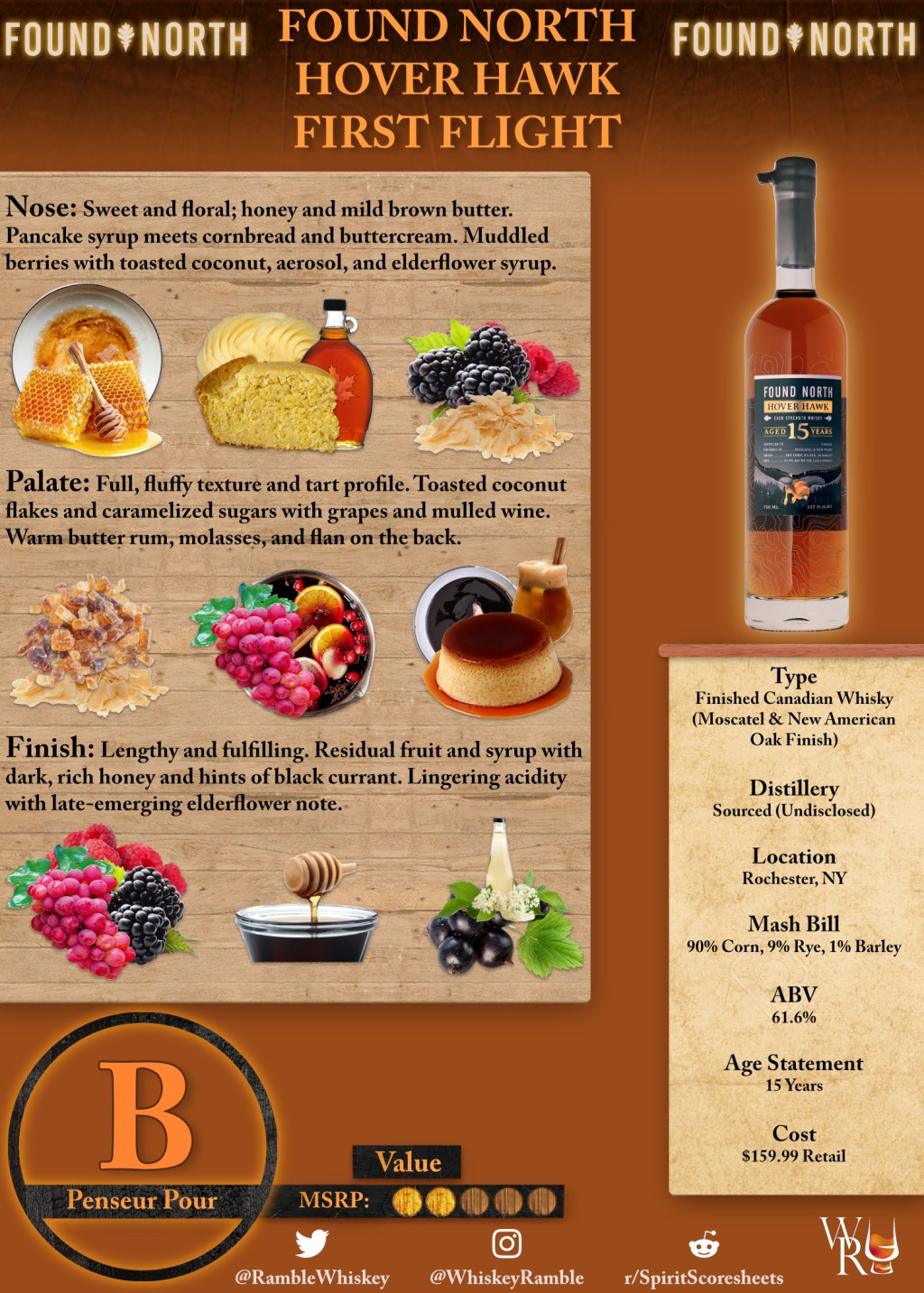
Now we finally come to the subject of today’s review, as well as the first in a series of Found North reviews that I have planned: Hover Hawk First Flight. Part of what Found North has dubbed the High Altitude Collection, the inaugural Hover Hawk release begins with a blend of 15 to 27-year-old whiskies (22, 23, 24, and 27-year corn, and 15 and 18-year rye) with a grain composition of 90% corn, 9% rye, and 1% barley, before undergoing a four-month-long finishing period in Moscatel and new American Oak casks. For context, Moscatel is a style of wine from Portugal with high sugar content that’s often used as a fortified wine, making it an easy choice for whisky finishing. The final bottling strength came out to a hearty 61.6% ABV, yielded 4,536 bottles, and cost about $160 retail.
Where Found North compare their batched products to sculptures that they chisel, sand, and polish, they liken the High Altitude Collection to gardening due to a combination of luck, nurturing, and coaxing of flavors from the secondary casks. Adding to the comparisons is the animal used on Hover Hawk’s front label: the North American Kestral, the smallest and most common falcon in the region. Found North decided on this bird for its “patience and wind-riding capabilities,” likening this to the time and patience needed to finish the whisky, allowing the team to reshape it “into its highest form.”
Nose: Comes on sweet and floral; honey-like with a mild brown butter backbone. An approximation of pancake syrup meets a more distinct presence of cornbread and buttercream. Over time, an exterior of muddled berries (blackberry and raspberry) appears, along with a unique mix of lightly toasted coconut flakes and aerosol. Elderflower syrup emerges after sipping.
Palate: Full, almost fluffy texture contrasts a fairly tart palate with an onset of toasted coconut flakes and caramelized sugars, quickly followed by bursting grapes and mulled wine. Butter rum, molasses, and flan round out the back palate while an overall warming presence ties everything together.
Finish: Lengthy and fulfilling. Residual fruit and syrup notes followed by dark, rich honey and hints of black currant. Showcases a lingering acidic essence that continues to play up the wine influence. That elderflower note from the nose makes a late emergence here, as well.
When I first got into distilled spirits, cask finishes were fun, exciting, and sometimes preferable to my impressionable palate. One explanation for this could be that finishes mask certain qualities in the base spirit. These same qualities can oftentimes be what the more accustomed enthusiast looks for, especially when looking at finished bourbons as a whole. The Canadian whiskies that Found North releases are a bit different, since they’re often generously aged, making the combination of mature product with cask finishes that much more interesting.
With Hover Hawk First Flight, I’m surprised that it takes a couple or so sips for the Moscatel to really hit me. But once it does, the ensuring tart and acidic fruit component hardly lets up, if at all. This makes for a curious combination with the whisky’s floral, grain-forward characteristics. It’s definitely a pour that screams “I’m in a unique mood”. I’d even say the powerplay is somewhat disjointed, but still better integrated than other products that make use of finishing casks, especially fortified wine. The good news is that Hover Hawk’s base is potent enough to support so much influence, resulting in a pour that absolutely catches one’s attention. For a first formal look at Found North, I’m intrigued to see how things unfold in the next few reviews.
 thewhiskeyramble.com
Leave a comment