
Becoming a hobbyist often carries the risk of eventual cynicism. For example, I’ve been into whiskey since 2018, and I’d be insincere to say that I’ve risen above all jaded thoughts or feelings. It’s an unfortunate yet inevitable reality for many of us, especially when it comes to distilled spirits, an expansive but mostly explored market. There are only so many times that producers can play with age statements, mash bills, distillation and barrel entry proofs, cask finishes, and even yeast strains before repetition settles in.
Despite this reality, one part of the whiskey industry that I remain interested in (and even excited by) is seeing newer producers release their own distillate, especially as some of it approaches the double-digit age range. Although supply and distribution have generally improved across the country, thereby allowing more people to have a chance to try these occasionally fun releases, there’s still an advantage to living close to these distilleries. Until recently, the closest notable distillery I lived to was in St. Augustine, a 4-hour drive from my hometown. Now that I basically live on the DC/MD border, it means I have easier access to more producers, including Sagamore Spirit.
Based in Baltimore, MD, Sagamore Spirit was formed in 2013 with an ambitious (albeit unoriginal) goal: to craft the world’s best rye whiskey. Considering the slow yet steady rise in popularity that rye whiskey continues to see, this is something of a tall order. Other fresh faces like New Riff, Peerless, and Driftless Glen have seen their own rye whiskeys come of age and the results have been nothing if not noteworthy. Between that and the positive reception to the well-crafted 8-Year rye (sourced from MGP) that Sagamore initially put out in 2021, it’s safe to say that the pressure was on for their first run of in-house distillate.
Speaking of 2021, that’s also the year Sagamore released their own whiskey to the public, which came in the form of their first bonded product. This initial batch came from whiskey distilled in the Fall of 2017, meaning it just met the age requirement for being bottled in bond. Sagamore has since released more Bottled in Bond batches, with each seeming to go up in age. Somewhat curiously, all of these seem to mention being distilled in Fall 2017, from the initial 4-year run to the 2A (as reviewed by Bourbon Culture) and even the 4A I purchased at the distillery last year. The likelihood that Sagamore held back some of the barrels isn’t surprising, but considering how plentiful the yields for each of these batches seem to be, it makes me wonder just how much of this rye whiskey they distilled in Fall 2017.
Now it’s time to see if a few releases and increased maturation time has resulted in a product that can stand with the aforementioned distilleries. Sagamore Bottled in Bond Batch 4A bears a 7-year age statement, was distilled and aged entirely by Sagamore, and retailed for $60 at the distillery. There’s no mention of chill filtration (or lack thereof). One minute distinction is that when Sagamore blends MGP, it’s usually a combination of 95/5 and 51/45/4 rye whiskeys; the blends using Sagamore’s own distillate (such as this) use their own 95/5 and 52/43/5 (Pursuit Spirits regularly cite this mash bill when sourcing from Sagamore) for the low-rye rye whiskey.
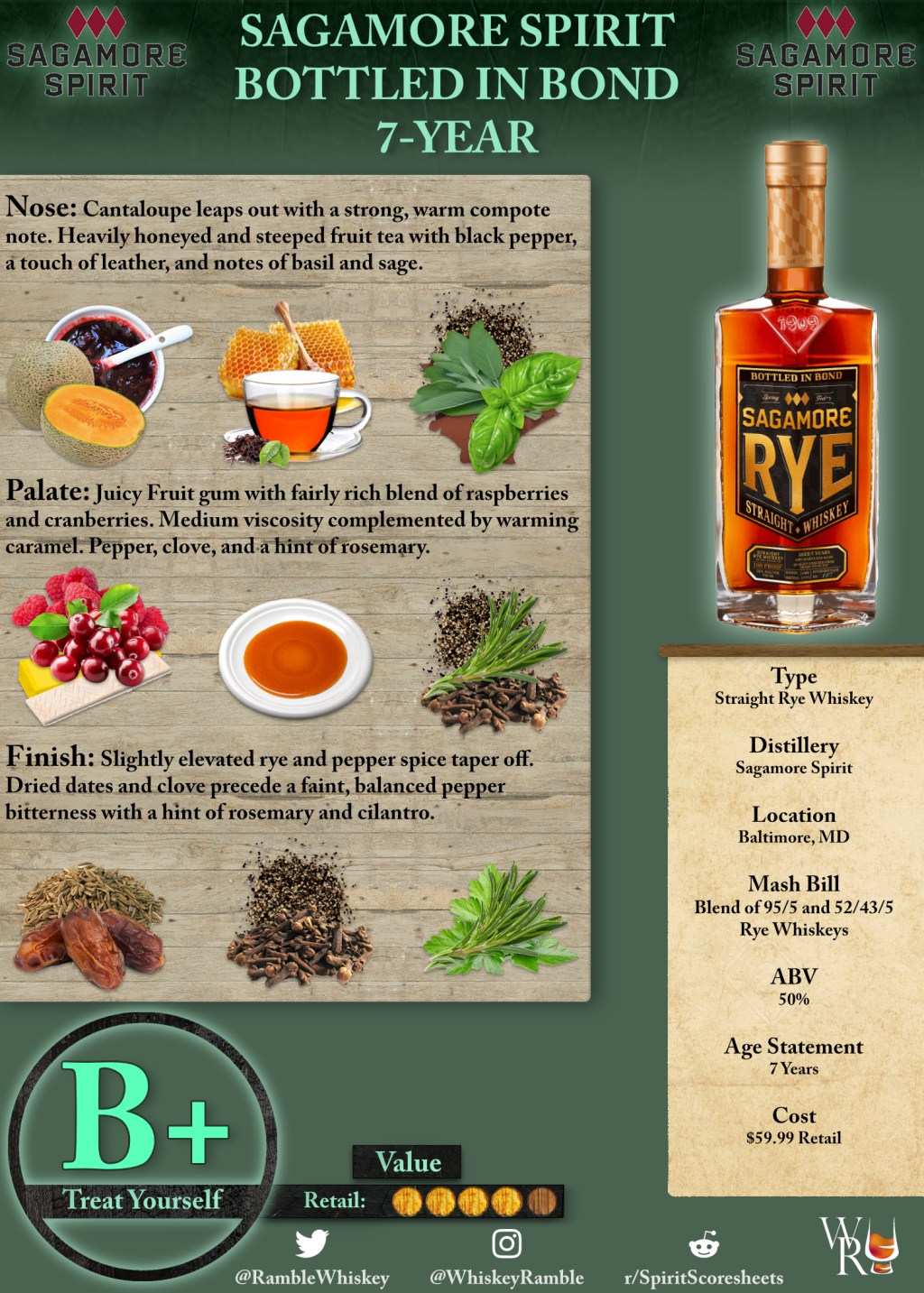
Nose: Bright, fruity, and sweetly herbal with a slightly savory underpinning. Cantaloupe leaps out of the glass with some complementary compote. There’s a strong layer of heavily honeyed and steeped fruit tea as well. The savory underpinning presents with black pepper and a touch of leather while the herbal notes manifest as basil and sage.
Palate: Explodes with Juicy Fruit gum before a more floral and herbal personality takes hold. Fairly rich blend of raspberries and cranberries over medium viscosity complemented by a warming caramel backbone. Pepper, clove, and a hint of rosemary offer an appropriate contrast on the backend while setting up the finish.
Finish: Slightly elevated rye and pepper spice gradually taper off in favor of dried dates, although the clove becomes more dominant with subsequent sipping. Closes out with a faint, balanced bitterness that leans on the refreshing side, evoking more rosemary and a hint of cilantro. Good strength and great length for the proof point.
Now that’s a fun rye whiskey. I’ve tried a handful of ryes from other recently established producers, and the spectrum can range from shockingly stellar to confoundingly unpleasant. Needless to say, this batch of Sagamore Bottled in Bond is far closer to the stellar end. The way this whiskey balances fruit, spice, and herbal qualities exemplifies what I believe most rye fans are looking for. It’s like a new band that captures the essence of the classics while offering just enough of a new spin to be distinct.
Since Sagamore has sourced from MGP for this long, I think many will ask how their own aged distillate stands up when compared. Is it necessarily a fair comparison? Perhaps not. But their experience and success with blending MGP ryes could’ve served as a goal post of sorts. To that end, I believe these early results are a resounding success. Most MGP ryes I’ve had lately either lean heavily into fruity, caramel sweetness, or bright and vibrant spice notes. Sagamore, by comparison, leans more floral and herbal with a touch of “farminess,” a word that should sound familiar to anyone versed in craft whiskey. The main difference with Sagamore is that this essence is actually subtle and reined in the point that it can be described as something else. Rather than detracting from the experience, it feels uniquely appropriate.
What I enjoy most about this whiskey is how consistent and comprehensive it is for the bottle strength. The nose instantly catches my attention while the palate keeps the momentum going before finishing with respectable—and borderline impressive—length. There’s a bit of a power play through the experience while it transitions from one dominant sensation to the other, be it fruity sweetness, florality, or spice. It might be 50% ABV, but the experience feels closer to 55% in all the right ways. Factor that in with an agreeable $60 price point and almost-constant availability at the distillery and you have the recipe for a killer rye whiskey worth paying attention to.

 thewhiskeyramble.com
Leave a comment