
It’s easy to develop tunnel vision when becoming more passionate about a hobby. Whisky is no different. And when it comes to scotch, few examples ring this truth as loudly as the Johnnie Walker line. In addition to being the world’s most popular scotch whiskey brand, the entry-level Red Label is Johnnie Walker’s top-selling expression. Yet if you procured online discussions, you’d think that Black Label might be the crowd favorite. At the very least, Johnnie Walker Black Label seems to be where the brand’s line starts for more discerning whisky consumers. Diageo must see (if not agree with) this on some level, considering any Johnnie Walker gift set with multiple bottlings consistently excludes the Red Label. So what exactly is the deal with the second entry up the blending giant’s totem pole?
Although the history of Johnnie Walker can be traced back as far as the early 19th century, its relevance as a scotch whisky brand didn’t technically begin until 1909. This was when sketch artist Tom Browne created the iconic Striding Man that adorns every Johnnie Walker bottle. Prior to that, the titular John Walker (then a grocer) started blending single malts to create a consistent profile. However, it was his son, Alexander Walker, who brought forth the Old Highland Blend whisky brand, which effectively became the Johnnie Walker we know today. Red, Black, and White labels were all introduced around this time, serving as successors to the Special Old Highland, Extra Special Old Highland, and The Old Highland, respectively. The brand quickly took off, reaching 1920 countries by the year 1920, followed by receiving a royal warrant from King George V in 1934.
Fast-forward to 1986 and Guinness acquired Distillers Company (DCL), who incorporated Johnnie Walker in 1925, followed by a merger between Guiness and Diageo in 1997. It’s comprised of an undisclosed blend of malt and grain whiskies sourced throughout Scotland, all aged a minimum of 12 years before being bottled at 40% ABV. It’s available just about anywhere spirits are sold at around $35 for a 750ml bottle.
Red Label was a challenging pour for the simple fact it brought so little to the table. I remember Black Label being a far more compelling whisky, so let’s see how true that holds.
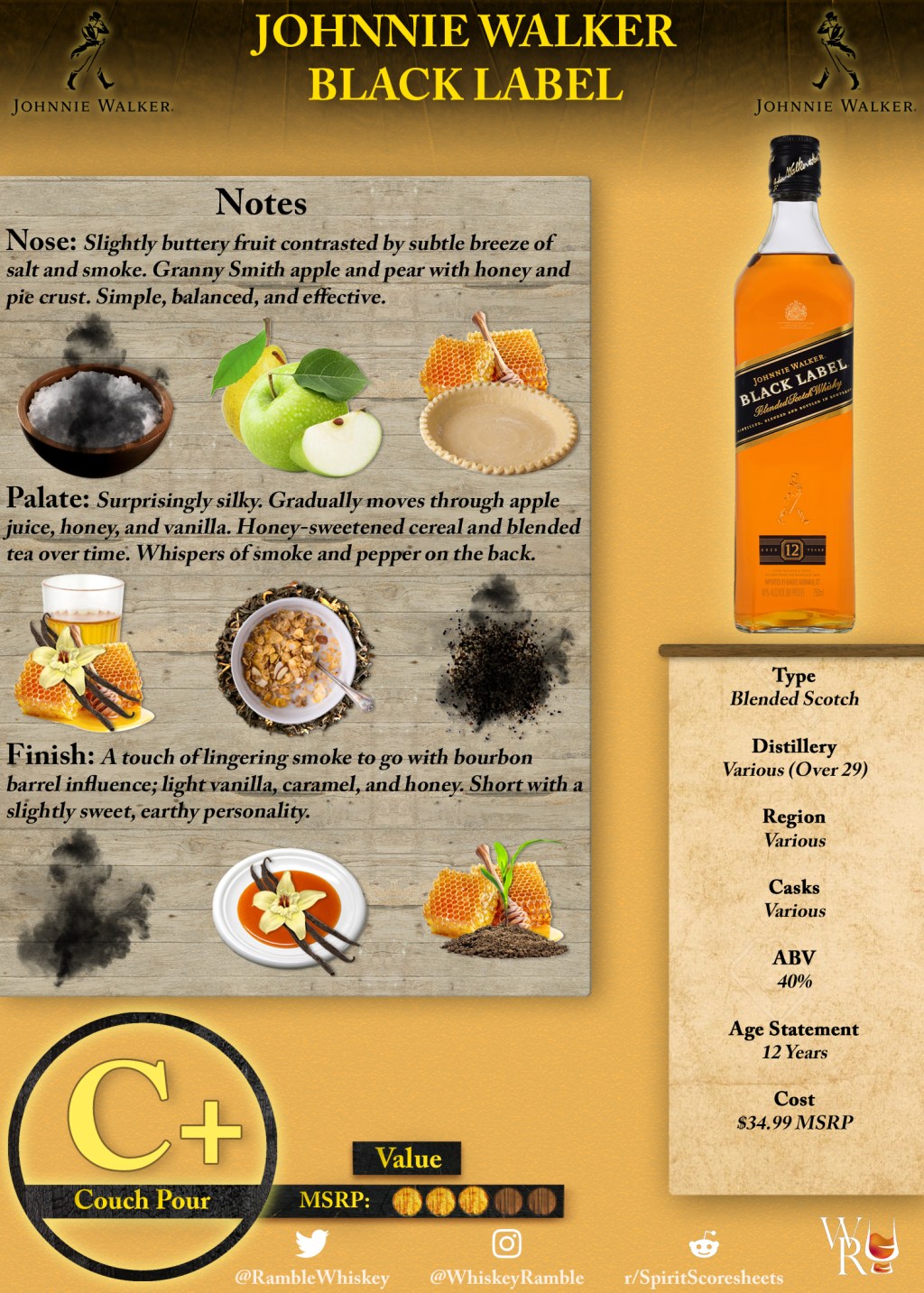
Nose: Slightly buttery fruit contrasted by a subtle breeze of salt and smoke. Granny Smith apple and pear with notes of honey and pie crust. Simple, balanced, and effective.
Palate: Surprisingly silky. Gradually transitions through apple juice, honey, and vanilla. Takes on more of a honey-sweetened cereal and blended tea personality over time. Whispers of smoke and pepper in the background on the backend.
Finish: Just a touch of lingering smoke to go with what’s almost certainly bourbon barrel influence; light vanilla, caramel, and honey notes. It’s short and brings a slightly sweet, earthy personality out for the final impression.
Part of me will always have a soft spot for Johnnie Walker Black Label. It wasn’t my very first scotch whsky, but I effectively consider it my introduction to the entire category. Much of this is thanks to how it’s able to showcase a somewhat multifaceted personality in such a cohesive way. Where some blended whiskies (like Red Label) do next to nothing productive with their components, Black Label doesn’t leave me struggling to pick apart its influences. It’s not a flavor explosion by any means—40% blended scotch from a massive producer isn’t bound to be, but if I had to point someone to a single bottle that more or less encapsulates what scotch smells, tastes, and feels like, this is what springs to mind.
The most consistent complaint I have with several entry-level OB scotches is that they’re often boring, especially for local prices. Johnnie Walker Black Label admittedly exhibits many of the same personality traits, but I think the discernible presence of peat in the blend adds a much-needed dimension to help it stand out. To that end, I think Black Label is a perfect example of blended scotch getting a bad rap for the wrong reasons. Many bottom shelf blends are absolutely to blame for this reputation, with Johnnie Walker as a whole often being lumped into the same camp. I can understand this perspective with Red Label, but Black Label is frankly too competent to deserve such contempt. Diageo might be easy to hate for many, but the team at Johnnie Walker knows what they’re doing when it comes to this everyday product. I’d like to see a bump in bottling strength with disclosure of no color added and non-chill filtration as much as the next person, but as it stands, Johnnie Walker Black Label resides comfortably within the realm of simple enjoyment. As a crash course or jack-of-all-trades, I struggle to think of a better option. It’s neither flashy nor particularly compelling, but it doesn’t need to be.

 thewhiskeyramble.com
Leave a reply to Just the Sip: Johnnie Walker Double Black Review – The Whiskey Ramble Cancel reply