
The whiskey industry is entering a potentially precarious position. Dust from the largely pandemic-born boom continues to settle while producers find ways to adapt to the shifting landscape. It wasn’t so long ago that a release could sell strictly on the laurel of novelty, but now? Customers and consumers alike are becoming more selective with their spending. Even with the blessing of brand recognition, acclaim, availability, and agreeable pricing, there’s still no guarantee that a product will be a reliable seller for the producing company.
This is where A. Overholt Monongahela Mash comes into play. Overholt is actually the oldest continuously maintained brand in American whiskey (not to be confused with oldest continually operating American distillery, which goes to Buffalo Trace), dating back to 1810. For a time, it was highly regarded, such that it became a go-to for the likes of Ulysses S. Grant and John Henry “Doc” Holliday. The Overholt name itself was actually a progression from Overhold, itself an anglicization from the original family name, Oberholtzer.
Many whiskey drinkers recognize the Overholt name as a Kentucky-produced spirit, but like Michter’s, the brand’s roots come from Pennsylvania which, along with West Virginia, is home to the Monongahela River. This river actually lifts its name from a Native American culture dating back to AD 1050. After surviving Prohibition, Overholt survived through National Distillers only to be sold to Jim Beam in 1987, along with two other “Old” brands: Old Crow and Old Grand Dad. “Survived” really is the key word here, since whiskey (especially) rye fell woefully out of favor after the triple-whammy of two World Wars and Prohibition.
Perhaps it’s of little surprise that, after transferring ownership to Jim Beam, Overholt degraded into a bottle-shelf, barely-legal Kentucky rye whiskey. However, thanks to the aforementioned whiskey/bourbon boom, Beam started paying attention and doing a bit more with the Overholt brand, including the release of A. Overholt Monongahela Mash, a whiskey that harkens back to Overholt’s origins. This is more of an “inspired by” than a “replication of” situation, with the 4-to-1 rye-to-barley mash bill itself being the key point of interest. Were this a true recreation of Monongahela rye, then whiskey would undergo a sour mash (really common), utilize water sourced from the Monongahela River, and likely be distilled in PA on a three-chamber still. When we consider that Beam paused production at one of their facilities and how expensive three-chamber still production can be (see: Leopold Brothers), it’s of little surprise that these concessions were made.
Regardless of nuance, introducing a rye whiskey with 80% rye and 20% malted barley that’s both widely available and affordable ($39.99 MSRP) is hardly a common occurrence, least of all from a legacy distillery. I’m sure part of what made the point of entry so agreeable was the fact the whiskey is proofed down to 95, which is still higher than your average shelfer product. Not to mention the lack of chill filtration is a welcome factor. In any case, let’s see how Jim Beam fared with producing this inspired product.
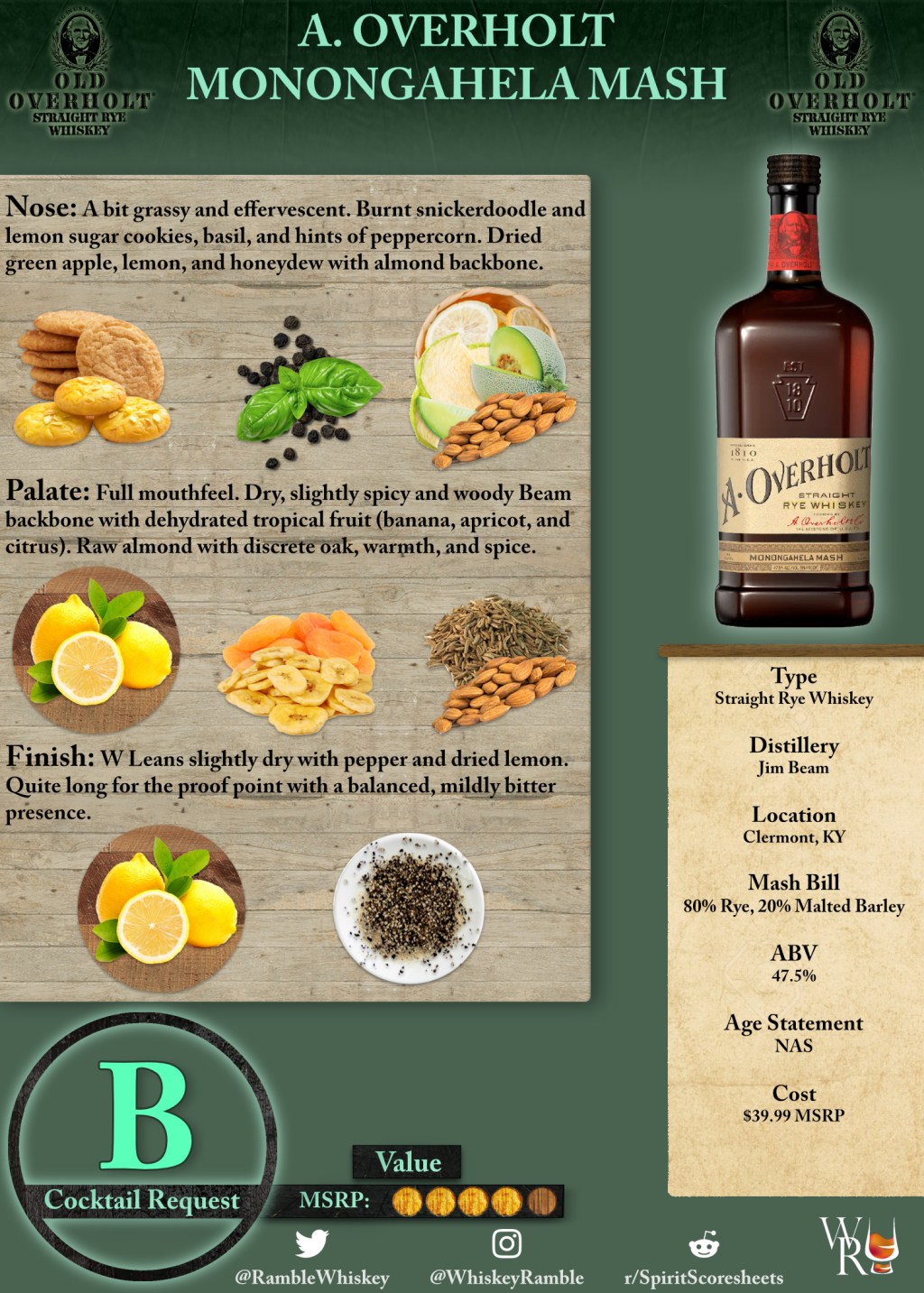
Nose: A bit grassy and effervescent. Slightly burnt snickerdoodle and lemon sugar cookies, some basil, and hints of black peppercorn. Dehydrated green apple, lemon, and honeydew with a mild almond presence in the background.
Palate: Surprisingly full. Has that dry, slightly spicy and woody Beam backbone, but with more of a dehydrated tropical fruit vibe, including banana, apricot, and citrus. Tangible maltiness manifests and coalesces naturally with the core Beam nuttiness, bringing more as a raw almond note. It’s distinct yet reigned in with a discrete presence of oak, warmth, and spice.
Finish: Leans slightly dry with pepper and dehydrated citrus (lemon). Quite long, especially considering the proof point. Balanced, mildly bitter presence slowly closes things out.
If you’re wondering whether A. Overholt’s relatively unique mash bill is enough to push through the typical Beam profile hallmarks, the answer is an un-resounding “kind of, but not really.” That dry, woody and generally nutty profile is very much present, yet it’s joined by an assortment of notes that Beam doesn’t typically display. The dehydrated citrus and tropical fruit notes stand out, both on their own and in combination with Beam’s usual flavors. When I first tried A. Overholt, the word that sprung to mind was “tropical trail mix,” and I stand by that description.
All of this is to say that A. Overholt is a fun pour that does well to distinguish itself in a crowded field. It holds up well neat and comes bottled at an agreeable enough proof point to satisfy both casual and enthusiastic drinkers. Though certainly a fun and interesting neat sipper, I think it stands out most as an elevated cocktail pour. It’s actually become a recent favorite of mine while making a Sazerac, and I’m already planning to buy another bottle or two just to have on standby. Don’t sleep on this little gem of a rye.


Leave a Reply