
Whisky is very much a product of its environment. Wherever the aging spirit physically resides will impact how the final product comes out, from the surrounding climate to the casks chosen for maturation. One of the more interesting ways whisky can take on a unique personality is through coastal influences. And when it comes to maritime qualities, few brands will come to mind quicker than Talisker.
The Talisker distillery, formed in 1830, resides on Carbost and is the oldest working distillery on the Isle of Skye. “Where rugged coastlines meet the raging sea” is the brand’s key marketing pitch. Strictly speaking, this isn’t a disingenuous way to describe the whisky, as many claim it possesses briny characteristics. Although the whisky takes on some peaty influence as well, it’s not to the same extent as Islay brands. Taking up the flagship bottling mantle is the revered Talisker 10-Year. According to distiller.com, its peat level is around 16-22 PPM and is mostly aged in ex-bourbon casks “constructed to a larger hogshead size.” Its bottling ABV is a bit higher than other flagship products at 45.8% and, in my experience, has highly volatile pricing depending on your market. The cheapest I’ve seen it for is just over $60, but $80 tends to be the more common asking price.
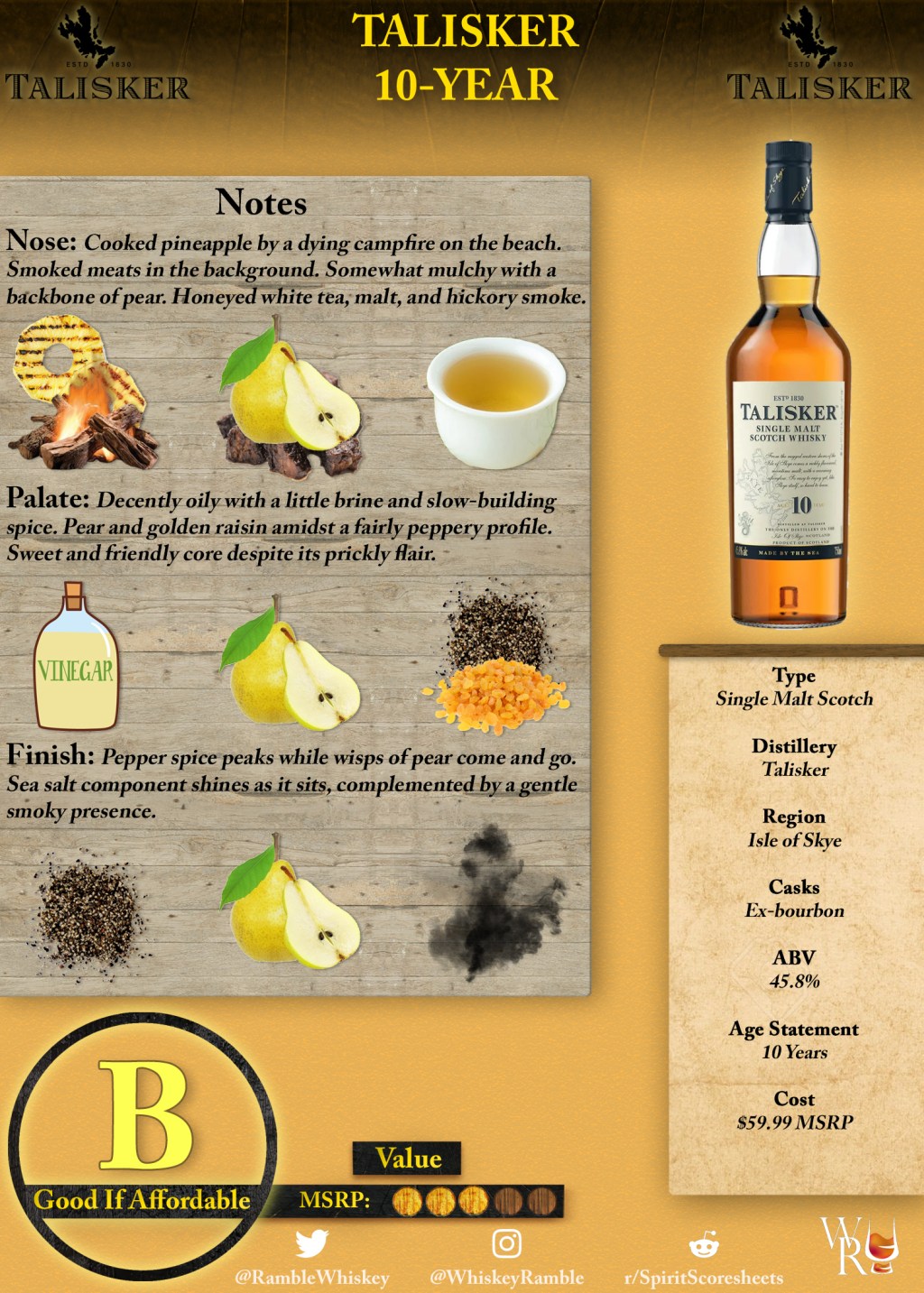
Nose: Cooked fruits by a dying campfire on the beach. Maybe some smoked meats in the background. Somewhat mulchy with a backbone of pear to keep things familiar. Generously honeyed white tea and lightly grilled pineapple. Post-sip sees the fruit and malt notes shine, but there’s still an approximation of hickory smoke in there.
Palate: Decently oily with a little brine and slow-building spice. Notes of pear and golden raisin amidst a fairly peppery profile. The core of the experience remains sweet and friendly despite its prickly flair.
Finish: Pepper spice peaks while wisps of pear come and go. Sea salt component shines as it sits, complemented by a gentle smoky presence.
About a year I reviewed Talisker Select Reserve Greyjoy, a bottle that instantly won me over and never let up from neck to foot. I’m happy to report that the more available and ubiquitous 10-Year checks many of the same boxes. I no longer have the aforementioned Greyjoy bottle to compare, but I feel like the HBO tie-in had slightly more contributing to its relatively exciting experience. Not substantially, mind you, but enough to make a difference. However, this could also be due to my more impressionable palate at the time. Furthermore, I have more whisky (including scotch) under my belt, so the chances that a flagship bottle might leave a strong impression are slim.
The good news is that these factors do little to detract from this being a great scotch for any time of the year. Spring and summer? The fruit notes will do the trick. Fall and Winter? Bring on the smoke and brine. Only one thing keeps this from being a staple — and it’s a common grievance of mine: pricing. Once again, I generally see Talisker 10-Year for $80 before tax. My budget is more flexible than a couple years ago, but $80 remains a staggering cost for a bottle of booze. I’m just glad this came from a 200ml bottle in the Diageo Coastal Collection for $35 because the idea of blindly dropping $80 for a bottle of this absolutely treads regretful territory. $60 would be easier to swallow for a recurring purchase, but some strong hitters are still in that range, including Bunnahabhain and Highland Park 12-Year. The end result is that Talisker 10-Year is more a victim of my market than anything.


Leave a Reply